
Our paper titled “Geometric Inconsistency Localization in Multi-View Image Sets” was accepted at the 2nd Deepfake Forensics Workshop (DFF 2026) at the ACM Multimedia (ACMMM) 2026.
In this paper, we investigate geometric consistency in multi-view image sets as a signal for multimedia forensics. While AI-generated images can appear realistic when viewed individually, maintaining a consistent underlying 3D geometry across different viewpoints remains challenging. Existing multi-view consistency methods have primarily been designed to evaluate novel view synthesis models rather than to localize inconsistencies for forensic analysis, making them less suitable for this task.
To support research in this direction, we introduce DeformView, a new benchmark dataset for geometric inconsistency localization. DeformView contains over one thousand 3D objects rendered from multiple viewpoints, together with controlled geometric deformations and pixel-level ground-truth annotations. Unlike previous datasets, DeformView enables the evaluation of wide-baseline image pairs and includes challenging hard negatives that require reasoning about cross-view consistency rather than appearance alone.
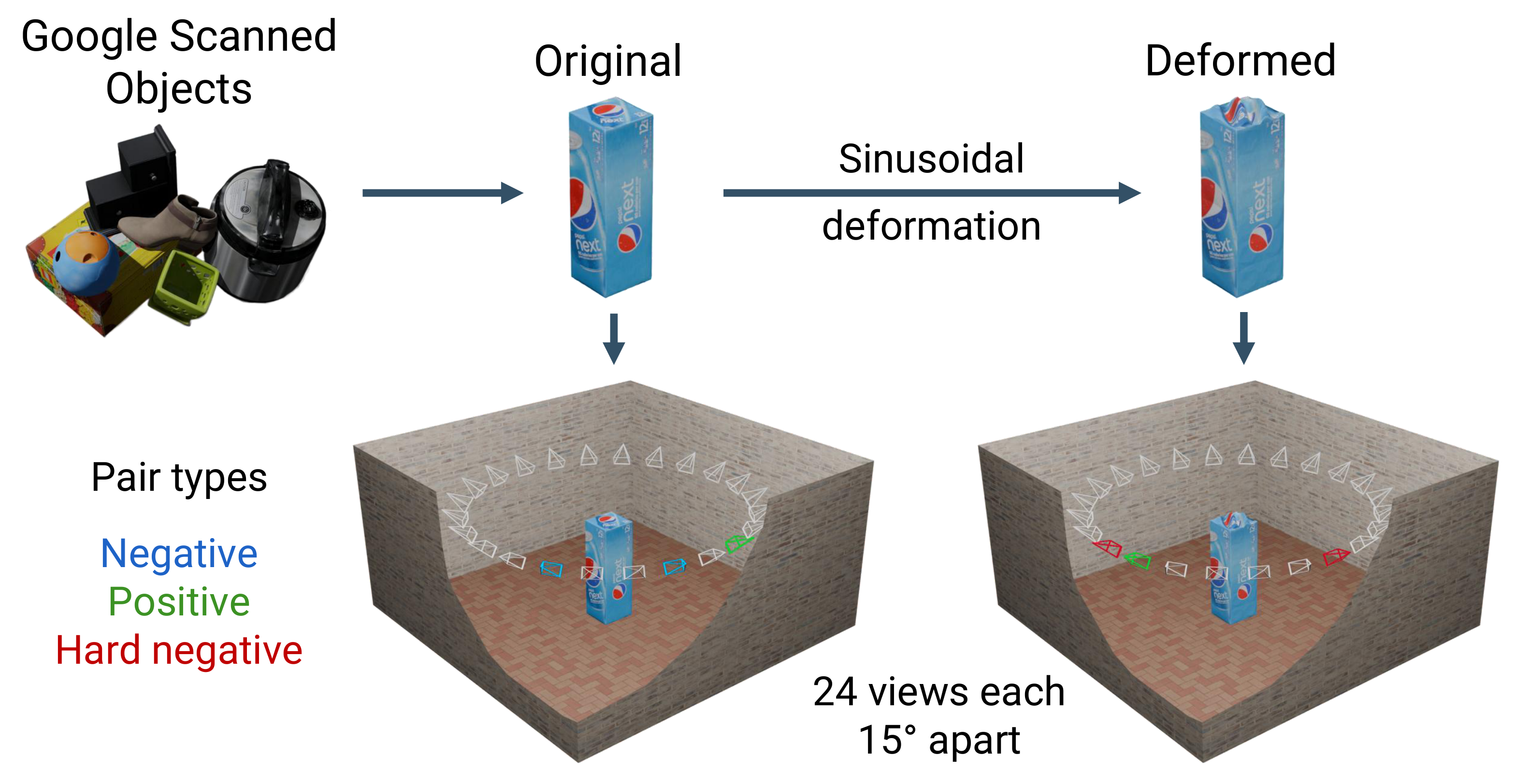 Overview of the proposed DeformView dataset and pair creation. There exist 3 pair types: Original-original (negative), Original-deformed (positive), and Deformed-deformed (hard negative).
Building upon this dataset, we propose DEFECt3R, a lightweight learning-based model for pixel-level geometric inconsistency localization. Instead of directly interpreting feature differences as evidence of manipulation, DEFECt3R learns to distinguish genuine geometric inconsistencies from correspondence errors and visually unusual but geometrically consistent regions.
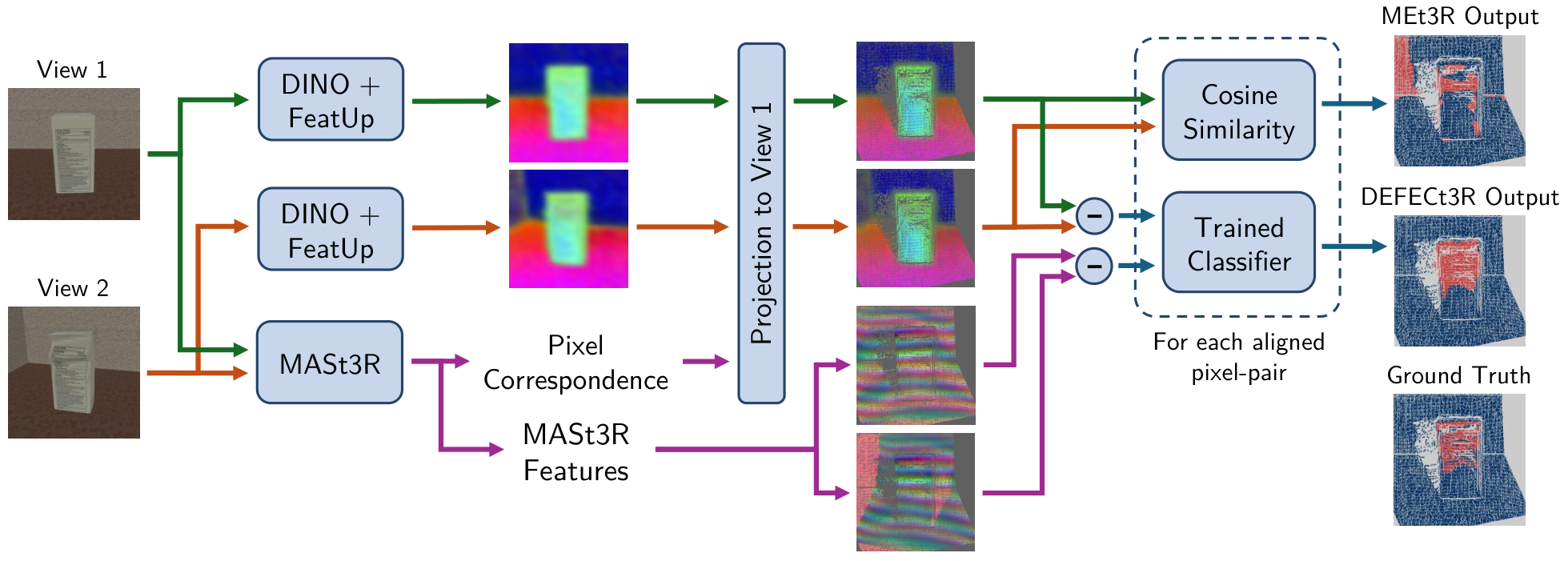 Overview of the proposed DEFECt3R framework for geometric inconsistency localization across wide-baseline image pairs, and its connection to MEt3R.
We evaluate DEFECt3R on the DeformView benchmark and compare it against existing multi-view consistency approaches. Our experiments show that state-of-the-art consistency metrics transfer poorly to forensic localization tasks, while DEFECt3R consistently achieves higher localization performance and lower false-positive rates. The results further highlight the importance of accurate cross-view correspondences and demonstrate that geometric consistency remains a promising yet underexplored signal for multimedia forensics.
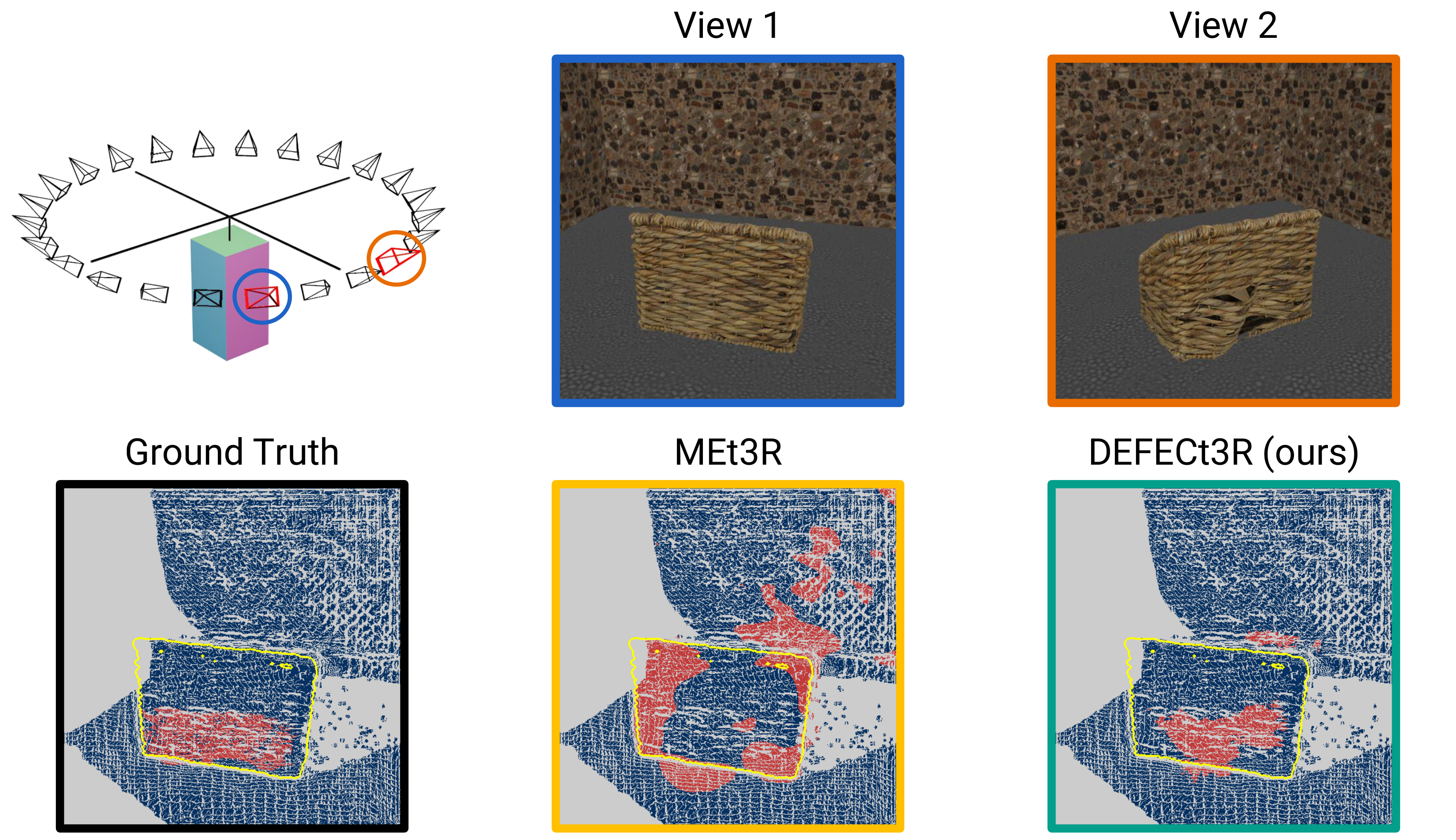 Example of a positive pair from the DeformView dataset, highlighting the improved localization performance and lower false-positive rate of DEFECt3R compared to MEt3R.
Dataset and code will be made available on GitHub.